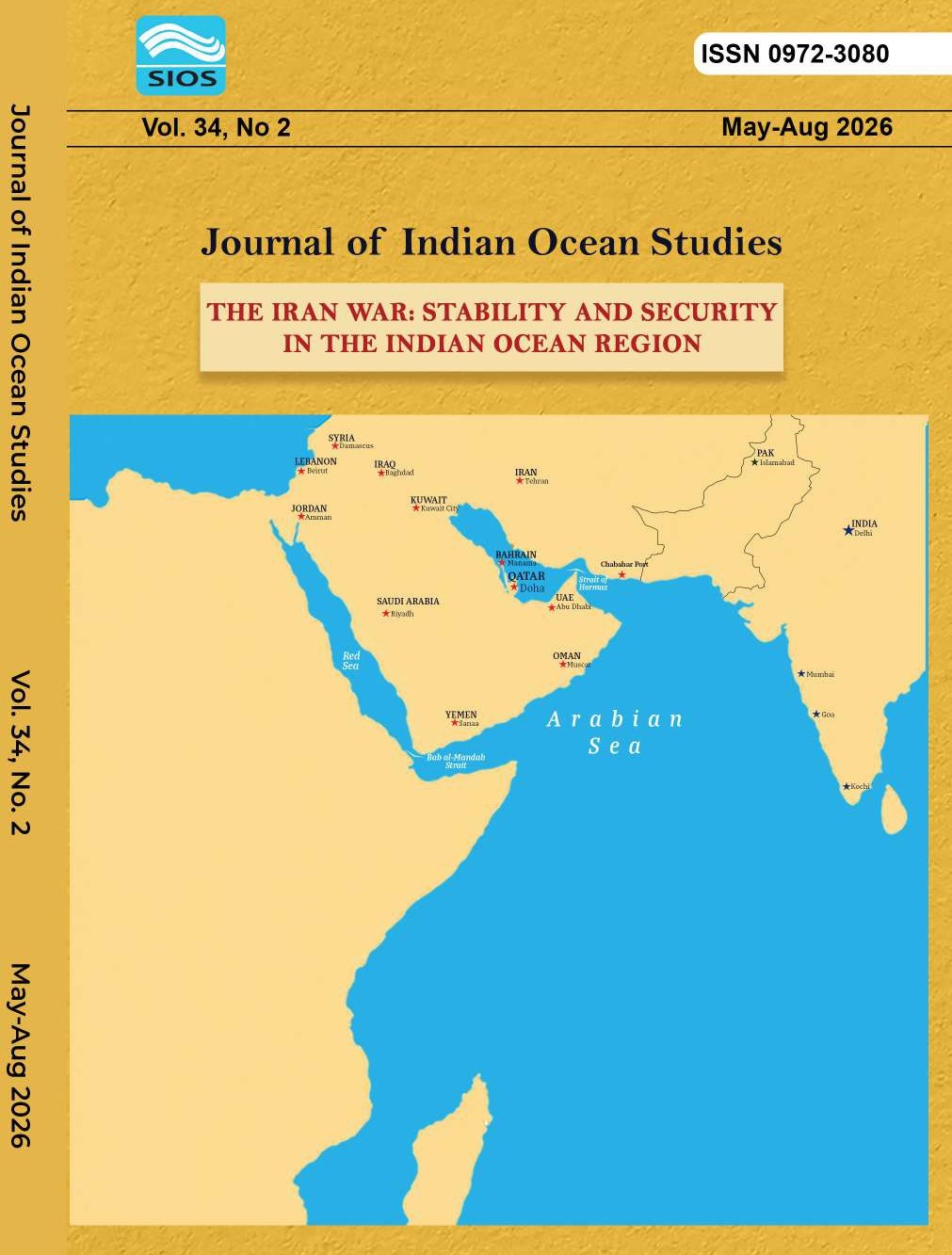


Journal of Indian Ocean Studies
Published in Association with Society of Indian Ocean Studies (SIOS)
Current Volume: 34 (2026 )
ISSN: 0972-3080
Periodicity: Tri-annual
Month(s) of Publication: April, August & December
Subject: Political Science & International Affairs
DOI: 10.32381/JIOS
Online Access is free for Life Member
The Strait of Hormuz as a Strategic Maritime Chokepoint: Lessons for India in the backdrop of US-Israel and Iran Conflict
By : Aaradhana Singh
Page No: 223-232
Abstract
The confrontation between Iran and the US-Israel axis has established the Strait of Hormuz as a multidimensional strategic space where maritime security, geo-economics, and great power competition come together. This recurring event has further demonstrated that India’s long-term security depends not only on acquiring advanced naval capabilities rather on energy diversification, strong and flexible supply chains, maritime diplomacy and gaining strategic autonomy. This academic exercise determines how the conflict has undermined the security of the Strait of Hormuz. The strait is responsible for the transit of around one-fifth of global oil and natural gas. In the twentyfirst century, these maritime routes have become increasingly significant. Global trade, energy transportation, and strategic connectivity depend on securing the sea lines of communication. Given India’s heavy reliance on Middle Eastern crude oil and natural gas imports, the article investigates the vulnerability of India’s supply chains in the event of any potential maritime disruptions. Various conflict trajectories, ranging from localised contestations to systemic maritime blockades, identifies critical operational thresholds that could catalyse severe inflationary pressures and domestic energy shortages. Every episode of escalation has impacts far beyond West Asia. The crisis has influenced global energy markets, disrupted maritime commerce, and reshaped diplomatic alignments. In India, the effect of the recent crisis has been realised specially when it reached Indian kitchen. Furthermore, the paper explores the geopolitical implications of the 2026 regional escalation, assessing how a change in maritime risk could redefine India’s energy diplomacy. The article also seeks to examine the lessons India could derive from the Iran and US- Israel escalations. The article argues that India’s response must extend beyond immediate crisis management. It should move towards building long-term resilience in energy security, maritime governance, defence preparedness, supply-chain diversification, cybersecurity, and diplomatic engagement. The study demonstrates that India’s ability to balance competing partnerships while safeguarding its national interests will determine its effectiveness as an emerging global power. The US-Israel and Iran conflict reinforces the necessity of a flexible, interest-driven foreign policy capable of adapting to an increasingly multipolar international order. It further argues that India must proactively diversify its energy procurement routes. It also needs to increase its reliance upon renewable energy resources.
The article also focuses on strengthening naval cooperation with littoral states to mitigate the existential risks posed by any regional instability.
Author
Aaradhana Singh is an Assistant Professor in Department of Political Science,Central University of Himachal Pradesh, Dharamshala. She has a teaching experience of more than six and a half years.
DOI: https://doi.org/10.32381/JIOS.2026.34.02.8